Loading...
Serving Springfield, VA and surrounding areas. (571) 788-4608
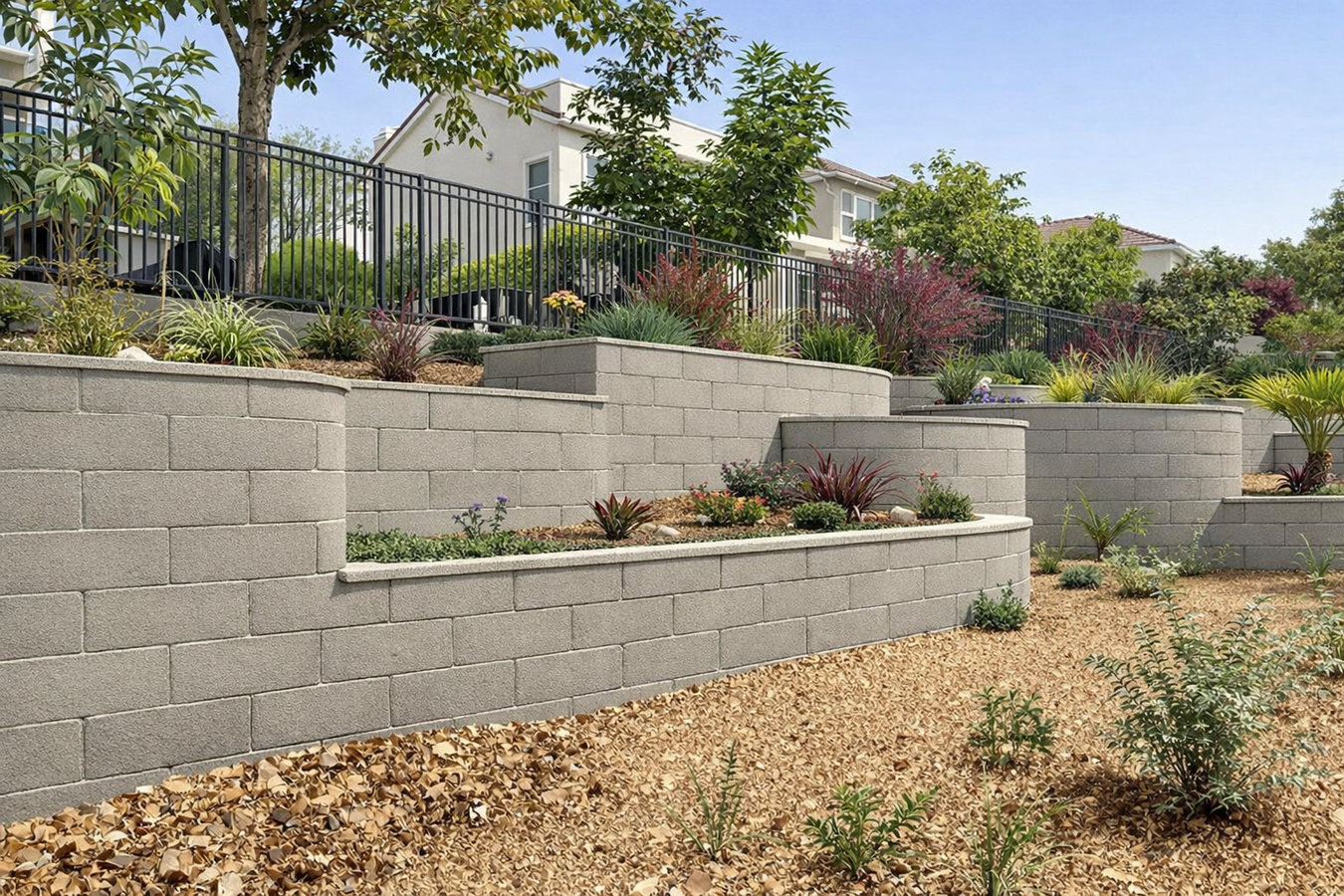
Springfield slopes and clay soil wash away yards and damage foundations. We build concrete retaining walls that hold firm through every season.
Concrete retaining walls in Springfield hold back slopes, stop erosion, and create usable flat space on your property - most residential jobs take two to four days of active construction, plus cure time before the area is fully restored.
If you have watched soil wash down a hillside after every rainstorm or noticed an old wall starting to lean, you already know the problem is only going to get worse. The clay-heavy soil throughout Fairfax County shifts with every wet season, putting constant pressure on slopes and any structure meant to hold them. A properly built concrete retaining wall - with drainage built in behind it - stops that cycle for good.
Many Springfield homeowners also add a wall to convert a steep, unusable hillside into a flat terrace for a patio or garden. If you are thinking about outdoor living space, our concrete floor installation work pairs well with a new retaining wall to build out a complete outdoor area.
If soil, mulch, or gravel migrates down a hillside after every storm, your slope is eroding. Springfield gets significant rainfall through spring and summer, and without something holding the soil in place, erosion gets worse with each event. Left alone, that soil ends up in your driveway, your foundation, or your neighbor's yard.
Stand back and look at your retaining wall straight on. If it tilts forward even slightly, or if you see horizontal cracks running across it, the wall is under stress it was not designed to handle. In Springfield's clay soil, this usually means water pressure has built up behind the wall. A leaning wall does not fix itself and can fail suddenly.
If standing water consistently collects at the bottom of a sloped area in your yard, water is running off the slope faster than the clay-heavy ground can absorb it. A retaining wall with proper drainage redirects that water and protects your lawn, garden beds, and home's foundation from the repeated soaking.
If the edge of your driveway, patio, or walkway is cracking, sinking, or pulling away from the surrounding ground, the soil beside it may be shifting. This is common in Springfield neighborhoods where lots have grade changes near paved surfaces. A retaining wall along that edge stabilizes the soil and stops the damage from spreading.
We build poured concrete retaining walls for residential properties throughout Springfield and Fairfax County. Every wall includes proper gravel drainage backfill and a footing set below the frost line - two details that separate walls that last decades from walls that start leaning within a few years. We also handle Fairfax County permit applications for walls over four feet tall, so you do not have to navigate that process yourself. For yards where the wall will create a new flat terrace, we can pair the job with concrete steps construction to connect the new level to the rest of your property.
Some homeowners in Springfield need a wall primarily to stop active erosion on a steep, wooded lot - often one with mature oak or maple root systems nearby that complicate placement. Others need a wall to stabilize a driveway edge that has been slowly crumbling for years. We assess each site before recommending a wall height or design, and we will tell you honestly if a smaller fix would solve your specific problem.
Best for homeowners with an eroding slope, an unusable hillside, or a driveway edge that needs structural support.
Best for homeowners with an existing wall that is leaning, cracked, or no longer holding back soil effectively.
Best for steep lots where a single tall wall is not practical - multiple shorter walls create usable terraced levels.
Best for walls over four feet tall that require Fairfax County review - we manage the permit and inspection process from start to finish.
Springfield's established neighborhoods - many built on lots with significant grade changes and decades-old tree cover - create the exact conditions that make retaining walls fail or necessary in the first place. The native Piedmont clay soil throughout Fairfax County expands when it absorbs rain and contracts when it dries, which means the soil behind any wall is always in motion. Contractors who do not account for this with proper drainage and a frost-depth footing are building a wall that will need replacing within years. Homeowners in Burke and Fairfax face the same clay and frost conditions as Springfield, and we build to the same standard across all of those neighborhoods.
Fairfax County also has specific permit requirements for walls over four feet tall, and a large share of Springfield's residential communities are governed by HOAs that require written approval before structural work begins. We ask about both before any work is scheduled. Getting county and HOA sign-off first prevents the frustration of being asked to modify or remove a wall after it is already built - something that comes up more often than most homeowners expect. Fairfax County building permit requirements are publicly available and worth reviewing if you want to understand what is required before calling anyone.
Reach out by phone or through our contact form. We reply within one business day and schedule a free on-site visit - no phone estimates for a job like this.
We walk your property, measure the area, check soil and grade conditions, and confirm whether a Fairfax County permit is required. You get a written estimate with no pressure to decide on the spot.
If a permit is needed, we handle the Fairfax County application - typically two to four weeks before work can begin. On construction days, we excavate, set the gravel drainage base, form, and pour. Most walls take one to three active days.
The wall cures for several days before we backfill and restore the area. We walk through the finished work with you, and if a county inspection was required, we coordinate that and give you the final documentation.
Free on-site estimate. No obligation. We handle Fairfax County permits.
(571) 788-4608Every wall we build includes gravel drainage backfill and a perforated drain pipe behind the wall. In Springfield's clay soil, this is what separates a wall that lasts 50 years from one that starts leaning after the third wet spring. You will not see the drainage once the job is done, but it is the most important part of the work.
We set every wall's foundation below the local frost line so the freeze-thaw cycles that hit Springfield each winter do not push the wall out of alignment. This is a step that shortcuts get taken on - a wall with a shallow footing can look fine in summer and be visibly leaning by March.
Fairfax County requires permits for walls over four feet tall, and many Springfield HOAs require written approval before any structural work. We ask about both before scheduling, handle the county application, and coordinate the final inspection. You stay out of the paperwork entirely. Virginia DPOR licensing is current and verifiable.
We will tell you straight if your existing wall can be repaired rather than replaced. Surface cracking and minor staining are usually fixable. A leaning wall or one with horizontal fractures is a different story. If someone immediately recommends full replacement on a wall with only surface-level issues, that is a conversation worth having a second opinion on.
These details - drainage, frost-depth footings, permits, and honest scoping - are what make the difference between a wall you never think about again and one that becomes a recurring headache. Call us at (571) 788-4608 or submit a request and we will schedule your free on-site estimate.
Pour a new concrete floor in your garage, basement, or utility space - built for Fairfax County soil and climate.
Learn MoreAdd concrete steps to connect the levels created by a new retaining wall or terrace.
Learn MoreSpring is the busiest season for retaining wall work in Northern Virginia - booking now means your slope is protected before the summer rains arrive.